In this guide
- Why the face changes with age
- Botox: for lines caused by movement
- Fillers: for lost volume
- Thread lifts: for mild sagging
- Botox vs fillers vs threads at a glance
- Which treatment do you need?
- Getting a natural result
- Combining treatments
- Treatments for men
- What decides the cost
- Myths about Botox and fillers
- Who should not have these treatments
- Before and after your appointment
- Planning around events
- Anti-ageing at Dr. K, Charni Road
- Frequently asked questions
Fine lines between the brows, a tired look under the eyes, cheeks that have lost a little fullness, a jawline that is less sharp than it was. These changes are normal, and there is no obligation to do anything about them. But if they bother you, non-surgical treatments can make a real difference without surgery or long downtime.
The three names you hear most are Botox, fillers and thread lifts. They are often mentioned in the same breath, but they do completely different jobs. Choosing the wrong one is the main reason people end up with a result that looks "done". This guide explains what each treatment does, how long it lasts, the risks, and how to plan a result that still looks like you. It is written by the team at Dr. K Skin Hair Advance Laser Clinic in Charni Road.
Quick answer: Botox relaxes the muscles that cause expression lines. Fillers replace lost volume. Threads lift sagging skin and stimulate collagen. Most people need one of these for a specific area, not all three everywhere. A good plan starts with how your face moves and where it has changed.
Why the face changes with age
To understand these treatments, it helps to know what actually changes:
- Muscle movement creates lines. Years of frowning, squinting and raising the eyebrows fold the skin in the same places. At first the lines appear only with expression; later they stay at rest.
- Volume is lost. Fat pads in the cheeks and temples shrink and shift, and bone changes slowly. The face can look tired or hollow, and folds around the nose and mouth deepen.
- Skin loosens. Collagen and elastin decline, so skin becomes thinner and less firm, and gravity shows along the jawline and neck.
- Skin quality changes. Sun damage, pigmentation and texture add to the tired look.
Each treatment targets one of these. That is why matching the treatment to the change matters so much.
Botox: for lines caused by movement
"Botox" is the best-known brand of botulinum toxin, a purified protein that temporarily relaxes the muscles it is injected into. When the muscle relaxes, the skin above it stops folding, and expression lines soften.
Good for:
- frown lines between the eyebrows,
- horizontal forehead lines,
- crow's feet at the corners of the eyes,
- a slight lift of the brow,
- a gummy smile, a dimpled chin, or bands on the neck, in selected cases,
- excessive underarm sweating, a medical use of the same treatment.
Not good for: lost volume, hollows, sagging skin, or lines that are present at rest because of volume loss.
What to expect: the treatment takes 10 to 15 minutes with a very fine needle. Most people see results in 3 to 7 days, with the full effect at about two weeks, and results usually last 3 to 4 months. Most people go straight back to their day. Small bumps settle within an hour, and a little bruising, if it happens, fades in about a week.
Possible side effects: redness, bruising, headache and, rarely, a drooping eyebrow or eyelid, which depends on technique and wears off as the treatment does.
Fillers: for lost volume
Dermal fillers are gels, most commonly made of hyaluronic acid, a sugar that occurs naturally in the skin and holds water. Injected under the skin, they restore volume, smooth folds and add structure.
Good for:
- hollow cheeks and under-eye hollows (tear troughs),
- deep folds from the nose to the mouth,
- thin or uneven lips,
- chin and jawline definition,
- temples and some deep acne scars.
Not good for: expression lines caused by muscle movement (Botox does that better), or loose skin that needs lifting.
What to expect: results are visible immediately. Swelling and possible bruising last up to about a week, sometimes two. How long a filler lasts depends on the product and the area: most hyaluronic acid fillers last from several months to over a year, and areas that move a lot, like the lips, wear off sooner.
A key safety point: hyaluronic acid fillers can be dissolved with an enzyme if needed. This is one reason they are preferred. Filler should only be injected by a trained doctor who knows the facial blood vessels, because injecting into a vessel is a rare but serious complication.
Thread lifts: for mild sagging
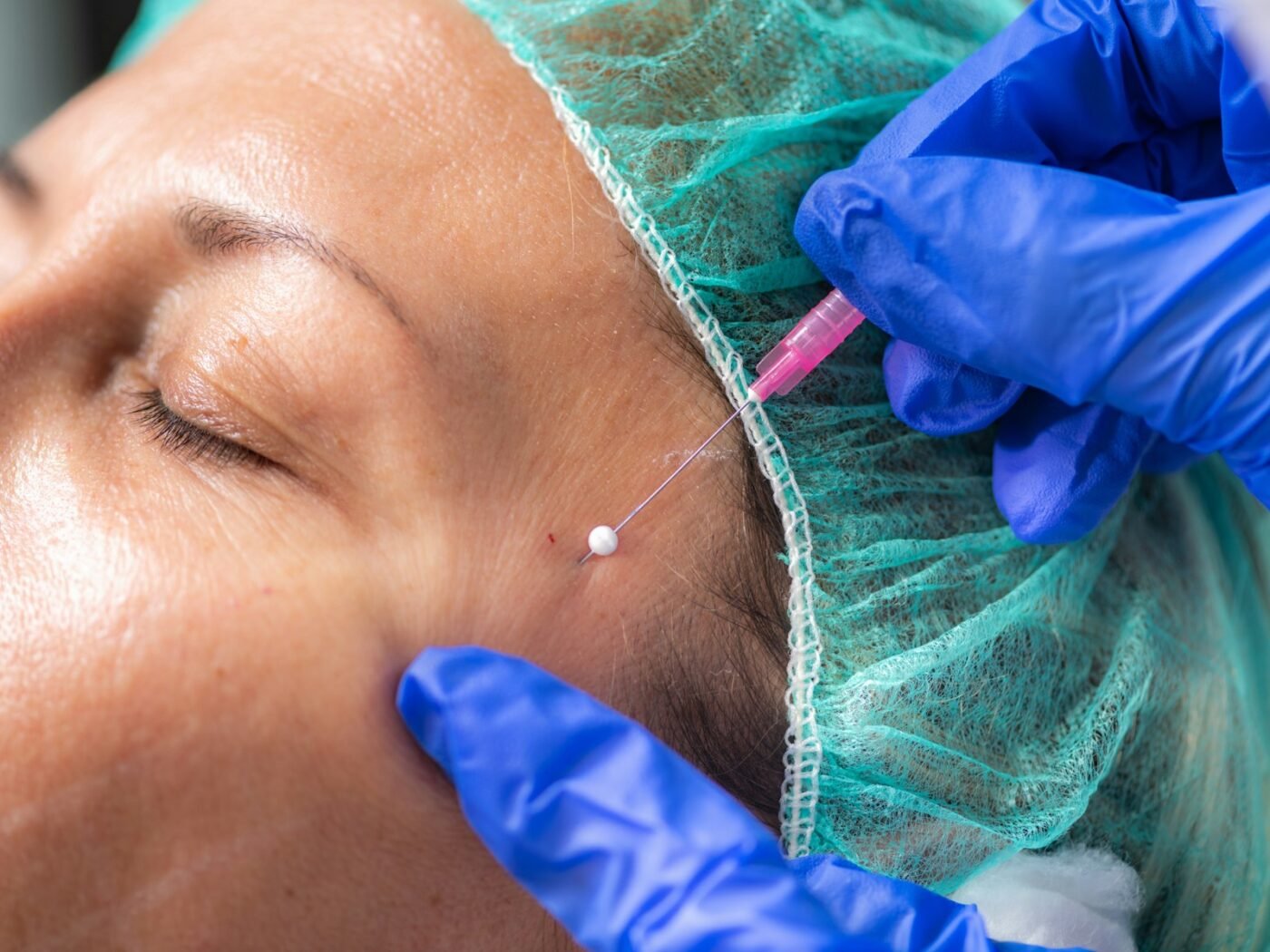
A thread lift uses fine, absorbable threads, commonly made of PDO (polydioxanone), placed under the skin with a thin needle or cannula. Some threads have tiny barbs or cones that grip the tissue and give a gentle lift. As the threads dissolve, they stimulate collagen, which improves firmness.
Good for:
- mild to moderate sagging of the cheeks and jawline,
- a softer jawline or jowls,
- lifting the brow slightly,
- improving skin firmness in people who are not ready for surgery.
Not good for: heavy sagging or a lot of loose skin, where surgery gives a better result, or volume loss on its own.
What to expect: a procedure of about 30 to 60 minutes under local anaesthetic. The lift is visible straight away and settles over a few weeks. PDO threads dissolve in about 6 to 8 months, and the lift and collagen effect are often reported to last around a year or longer, though long-term studies are limited.
Possible side effects: swelling, bruising, tightness or discomfort when opening the mouth for a few days, small dimples that usually settle, and, rarely, infection, a visible or extruding thread, or asymmetry.
Botox vs fillers vs threads at a glance
| Botox | Fillers | Thread lift | |
|---|---|---|---|
| What it does | Relaxes muscles | Adds volume | Lifts and firms |
| Best for | Frown lines, forehead lines, crow's feet | Hollows, folds, lips, chin, jawline | Mild sagging of cheeks and jawline |
| Time | 10 to 15 minutes | 20 to 45 minutes | 30 to 60 minutes |
| Results appear | 3 to 7 days; full at about 2 weeks | Immediately | Immediately, settling over weeks |
| Typically lasts | 3 to 4 months | Several months to over a year | Around a year or longer |
| Downtime | Almost none | Swelling or bruising for up to a week | Swelling, bruising, tightness for 1 to 2 weeks |
| Reversible? | Wears off | Hyaluronic acid can be dissolved | Threads dissolve over months |
Which treatment do you need?
A few examples show how this works in practice.
- "I look angry or tired when I'm not." Often frown lines between the brows. Botox is usually the answer.
- "My under-eyes look hollow and dark." Often volume loss under the eyes, sometimes with pigmentation. Filler may help the hollow; pigmentation needs separate treatment.
- "My smile lines are deep." Often cheek volume loss making the folds deeper. Replacing cheek volume can soften the folds more naturally than filling the fold itself.
- "My jawline isn't sharp anymore." Depending on the cause: filler for structure, threads for mild sagging, or skin tightening for firmness.
- "My skin looks dull and crepey." This is skin quality, not lines or volume. Skin boosters, skin tightening, peels and good sun protection often matter more.
Getting a natural result
The treatments that look "done" usually have one of three problems: too much product, the wrong treatment for the change, or everything treated at once. These principles keep results natural:
- Start with a consultation, not a menu. Dr. Kajal looks at your face at rest and in movement, and from different angles, before suggesting anything.
- Treat the cause, not just the line. A fold is often caused by volume loss higher up.
- Less, then review. A conservative first treatment with a review at two weeks. It is always easier to add a little than to take it away.
- Keep expression. Good Botox softens lines while leaving some movement.
- Respect your features. The aim is to look rested and fresh, not like someone else.
Combining treatments
Most faces change in more than one way, so the best results often come from a small combination rather than a lot of one treatment. For example:
- Botox for frown lines plus filler for under-eye hollows, for someone who looks tired and cross.
- Cheek filler plus a thread lift along the jaw, for mild sagging with volume loss.
- Botox for crow's feet plus skin tightening and sunscreen, when lines and skin quality both matter.
Combining treatments does not mean doing everything on the same day. Often it is safer and easier to judge the result when treatments are spaced a couple of weeks apart. Your plan should say what comes first and why.
Treatments for men
More men are asking about these treatments, often for the same reasons: looking tired at work, a frown that reads as angry, or a softer jawline. Men's facial muscles are usually stronger and the skin thicker, which affects the dose and placement. The goal for most men is a rested look with no sign of treatment, so a conservative approach matters even more.
What decides the cost
Prices are not comparable across clinics without knowing what is included. The main factors are:
- The product. Different brands of botulinum toxin and filler differ in cost.
- The amount needed. Botox is priced by units, fillers by syringe. A small area needs less.
- The number of areas. Treating frown lines alone costs less than frown lines, forehead and crow's feet.
- The type of threads and how many are needed for a thread lift.
- Who injects. A doctor with training in facial anatomy is essential for safety.
- Review appointments. Check whether a two-week review and any small top-up are included.
Ask for a written plan with the product, the amount and the total before treatment.
Myths about Botox and fillers
"Botox is poison." Botulinum toxin is a purified protein used in tiny, measured doses. It has been used in medicine for decades, including for eye conditions, migraines and excessive sweating. Safety comes from the correct dose, product and technique.
"Once you start, you have to continue forever." If you stop, the effect simply wears off and your face returns to how it would have looked. It does not make lines worse.
"Fillers stretch the skin." Used in sensible amounts, fillers restore lost volume. Problems come from overfilling, not from filler itself.
"Threads give the same result as a facelift." Threads give a subtle lift for mild sagging. For heavy sagging, surgery gives a very different result.
Who should not have these treatments
These treatments are not suitable, or should wait, if you:
- are pregnant or breastfeeding,
- have an active infection, cold sore or acne flare in the area,
- have certain neuromuscular conditions (for Botox),
- have a history of severe allergic reactions or problems with previous fillers,
- take blood thinners, unless your doctor has reviewed this,
- have unrealistic expectations, such as wanting to look like a filtered photo.
A good doctor will also say no when a treatment is not right for you.
Before and after your appointment
Before:
- Avoid alcohol for 24 hours before, and, if your doctor agrees, avoid painkillers and supplements that thin the blood for a few days. This lowers bruising.
- Do not book fillers or threads in the week before a big event. Botox needs two weeks to reach its full effect.
- Come with a clean face.
After:
- For Botox, stay upright for about four hours and avoid rubbing or massaging the area.
- For fillers and threads, avoid strenuous exercise, saunas and facials for a few days.
- After threads, avoid wide mouth opening, dental work and sleeping on your face for about two weeks.
- Use a cold compress for swelling, and contact the clinic if you notice severe pain, skin colour changes or signs of infection.
Planning around events
- Botox: 2 to 4 weeks before the event, so the full effect has settled and any small adjustment can be made.
- Fillers: at least 2 to 4 weeks before, to allow swelling and bruising to settle.
- Threads: 4 to 6 weeks before, as swelling and tightness take longer to settle.
Anti-ageing at Dr. K, Charni Road
At Dr. K Skin Hair Advance Laser Clinic, anti-ageing treatment starts with a consultation with Dr. Kajal Charaniya. She looks at how your face moves and where it has changed, explains which treatment fits each concern, and plans a conservative, natural result with a review built in.
The clinic is opposite Earth Castle Mall in Charni Road, open all 7 days from 12 to 9 pm. Read more on our Botox, fillers and threads page, or book a consultation.
Frequently asked questions
What is the difference between Botox and fillers?
Botox relaxes the muscles that cause expression lines, such as frown lines and crow's feet. Fillers are gels, usually hyaluronic acid, that add volume to hollows, folds and lips. Many people benefit from both, for different areas.
How long does Botox last?
Most people see results in 3 to 7 days, with the full effect at about two weeks. Results usually last 3 to 4 months.
How long do fillers last?
It depends on the product and the area. Most hyaluronic acid fillers last from several months to over a year; areas that move a lot, such as the lips, tend to wear off sooner.
Will I look frozen or fake after Botox or fillers?
Not when the dose and placement are planned for your face. A natural result keeps some movement and adds only what is needed. It is always easier to add a little more at a review than to take it away.
How long does a thread lift last?
PDO threads dissolve in about 6 to 8 months, and the lift and collagen they stimulate are often reported to last around a year or longer. Results vary with age, skin quality and technique.
Is there downtime after Botox, fillers or threads?
Botox has almost none; you may have small bumps or a little bruising. Fillers can cause swelling and bruising for about a week. Threads can cause swelling, bruising and tightness for one to two weeks.
References
- Botulinum toxin therapy: Overview – American Academy of Dermatology
- Botulinum toxin therapy: FAQs – American Academy of Dermatology
- Botulinum Toxin Injection for Facial Wrinkles – American Family Physician
- Fillers: FAQs – American Academy of Dermatology
- Thread lift – American Society of Plastic Surgeons
- Thread lifting materials: a review – Clinical, Cosmetic and Investigational Dermatology